
Charlottesville City Directory Collections
Charlottesville’s historical directory shelf is spread among Jefferson-Madison Regional Library, the University of Virginia, the Albemarle Charlottesville Historical Society, the Library of Virginia, NARA, and national library collections. Treat each volume as a separate snapshot. Some editions include Albemarle County, and a directory can preserve an old address or omit a household. That makes the exact year, edition, and locality note as important as the printed name.
| Directory collection | Years represented | Where held | How to use it |
|---|---|---|---|
| Charlottesville City Directory | 1898 | JMRL local-history documents | Free downloadable document; preserve the page image and citation. |
| Preservation-bibliography editions | 1895, 1898, 1904/05, 1910–1930 | Local preservation research with LVA, UVA, and ACHS leads | Confirm the exact shelf or call number before a visit. |
| Charlottesville microfilm reels 35–50 | 1904/05–1960, with listed gaps | Gale/Cengage directory inventory | Library or microfilm access; subscription location was not stated. |
| Hill’s Charlottesville, Vol. XV | 1934 | UVA Library / UVA annual-report image | View the report image; confirm full-run access with UVA, JMRL, LVA, or NARA. |
| NARA circa-1930 directories | 1929, 1931, 1934 | NARA microfilm | Reference access; Charlottesville entries include Albemarle County. |
None of these rows promises an unbroken annual run. The Library of Congress warns that directories were issued irregularly and that one volume may cover more than one community. A city directory is a compiled historical source, not a modern government resident file.
Charlottesville’s 1898 City Directory at JMRL
Jefferson-Madison Regional Library’s local-history documents provide a directly downloadable Charlottesville City Directory, 1898. That makes it a good opening volume when a family name or old address already points to the late nineteenth century. JMRL also makes local road studies and city-history material available, while its catalog is a useful first check for regional genealogy books and yearbooks.
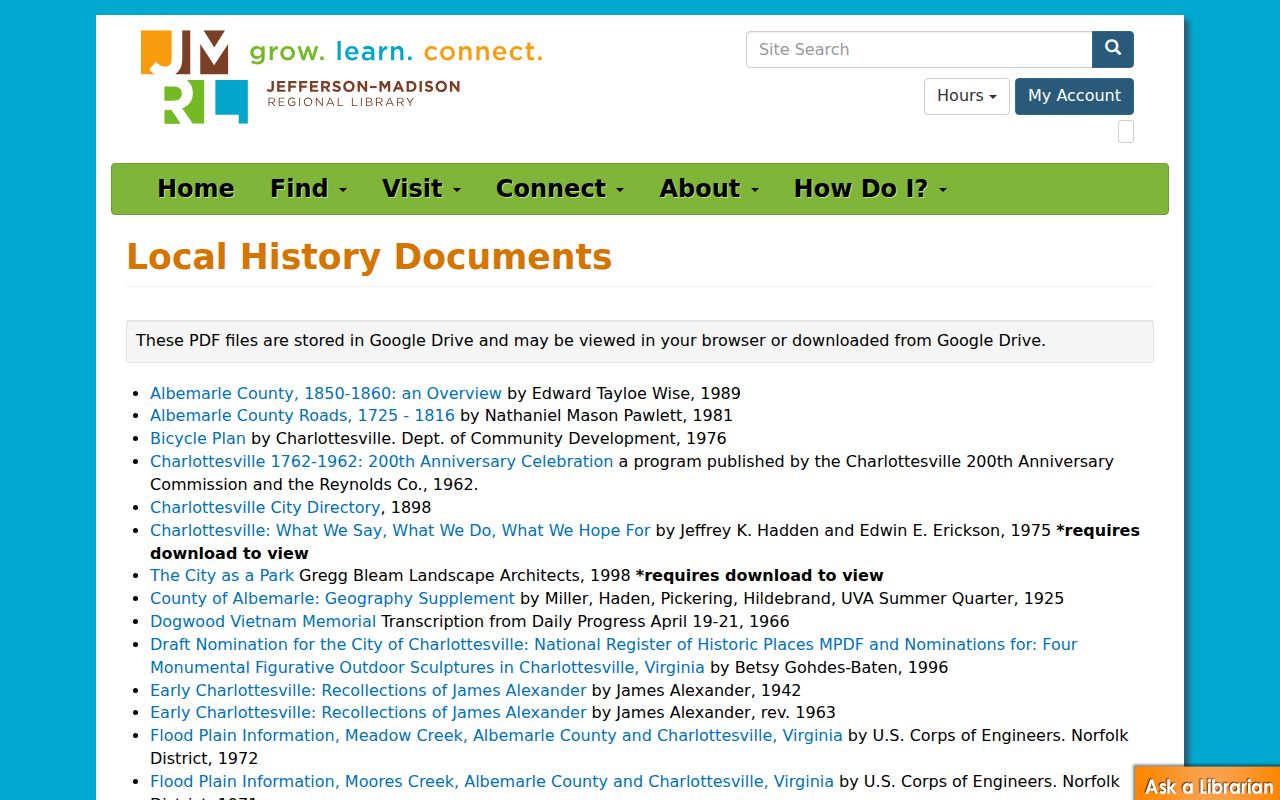
The JMRL document page does not claim a complete directory run. Use the 1898 volume as a dated lead, then test the same name or address in the microfilm inventory, UVA material, ACHS files, and the Library of Virginia catalog rather than assuming a missing year never existed.
Charlottesville City Directory Reel Gaps
The reel inventory offers a valuable numerical map of the local run. Reel 35 spans 1904/05–1916/17 but lacks 1908 and 1909. Reel 36 covers 1919/20–1927, with 1921 and 1926 absent. Reel 37 reaches 1929–1934, while 1930, 1932, and 1933 are listed as missing. Later reels also contain gaps, so a person’s apparent arrival or departure needs a nearby volume and a second source before it becomes a conclusion.
- 1904/05–1916/17: Reel 35, with 1908 and 1909 missing.
- 1919/20–1934: Reels 36 and 37, with gaps in 1921, 1926, 1930, 1932, and 1933.
- 1936–1947/48: Reels 45 and 46, with 1937, 1939, 1943, 1944, and 1946 missing.
- 1950–1960: Reels 47–50, with 1954 missing; the 1957–60 reels list several nearby suburban areas.
Overlapping 1953 on two reels should be treated as separate editions or a catalog issue until a librarian identifies the volumes. NARA’s 1929, 1931, and 1934 entries are a useful check for the early-1930s gap pattern, but NARA is a microfilm access point rather than a promised free scan.
Charlottesville’s 1934 Hill Directory Story
UVA’s 2023 annual report describes Hill Directory Co. of Richmond volumes for Charlottesville and Albemarle from the Jim Crow era, including Hill’s Charlottesville (Albemarle County, VA) Vol. XV, 1934. The report says UVA added directories useful for studying segregation and the University’s impact on nearby communities. That local history context is a reason to preserve the complete citation and to read a household entry beside neighborhood, newspaper, and archival sources.
| Title | Hill’s Charlottesville (Albemarle County, VA), Vol. XV |
|---|---|
| Publisher | Hill Directory Co., Richmond, Virginia |
| Visible year | 1934 |
| Advertised functions | Person to address, person to listed occupation, street number to resident, street location, name spelling, and business-officer or partner leads. |
| Coverage note | Charlottesville volume includes Albemarle County; compare locality before connecting it to a city parcel. |
The UVA annual report image preserves the 1934 volume and its “When You Want to Know” advertisement.
The wording shows why a name section and address section belong together. It does not prove that every entry has every advertised field, and the research did not expose a full individual 1934 entry for a field-by-field local claim.
Reading a Charlottesville City Directory Entry
Transcribe only what the printed entry actually shows. A name can be accompanied by a spouse or relationship notation, a listed occupation, street address, room or boarding notation, telephone, and a code mark. The exact local abbreviation key should control its interpretation. An unfamiliar mark is a reason to photograph or copy the key, not a reason to guess.
| Name spelling | Record initials, suffixes, and punctuation as printed, then search sensible variants separately. |
|---|---|
| Relationship notation | Keep spouse, widow, or other printed notation with the name; it can distinguish similarly named people. |
| Listed occupation | Copy it only when present. It is a date-specific identification clue, not proof beyond that edition. |
| Street or room address | Preserve the number, directional prefix, abbreviation, apartment, or boarding detail exactly. |
| Telephone or code mark | Record the exchange, number, or printed code and consult the volume’s key before interpreting it. |
- Criss-cross directory
- An address-ordered section that reverses the usual name lookup and can connect a printed street number to a listed household.
- Householder index
- A name arrangement focused on the principal listed person or household, not necessarily every person at the address.
- Abbreviation key
- The volume’s own explanation of short forms and code marks. Preserve it with any entry transcription.
Charlottesville City Directory Companion Shelves
The Albemarle Charlottesville Historical Society Research Library adds the local material that a directory alone cannot supply. Its more than 4,000 books are searchable through the JMRL catalog, and its partial vertical-file indexes cover businesses, families, houses of worship, schools, and wars. ACHS also points researchers to the digitized Daily Progress, Virginia Chronicle, Chronicling America, and Central Virginia Genealogical Association materials.
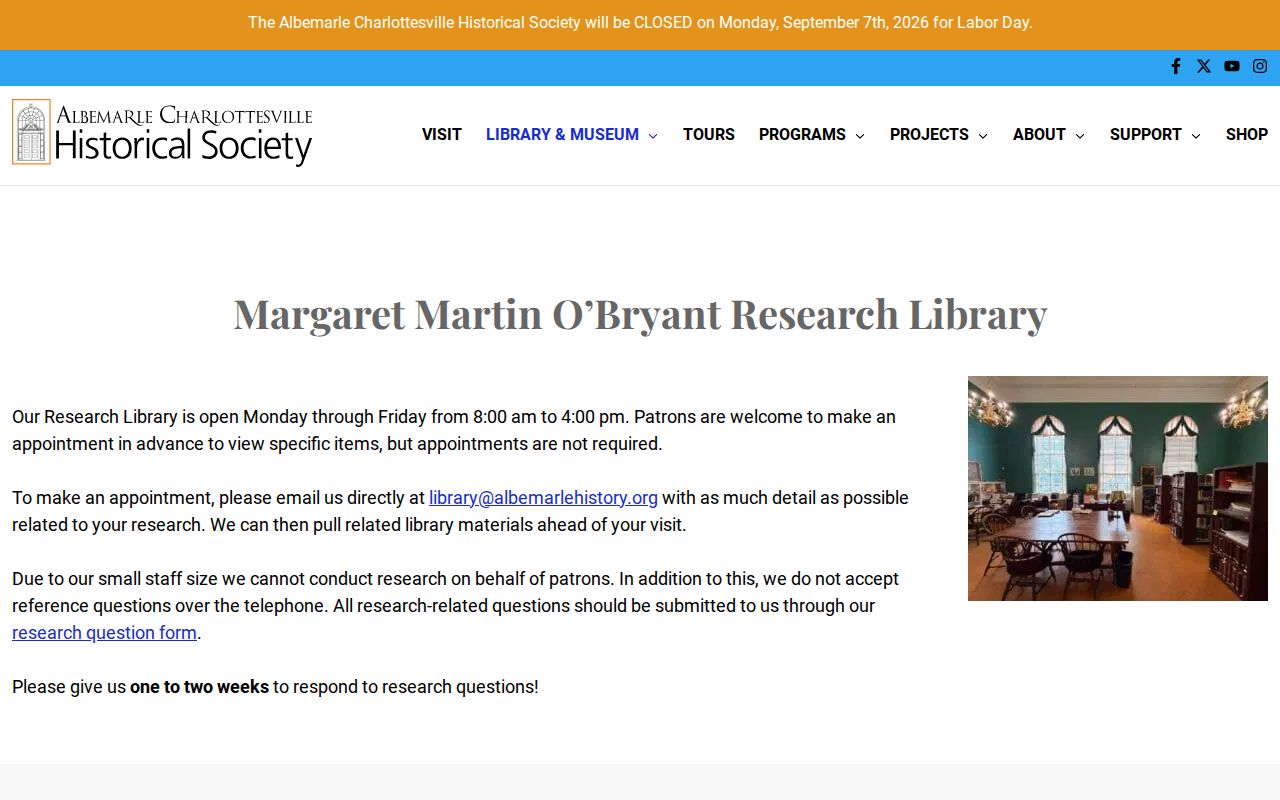
ACHS is at McIntire Library in Market Street Park, 200 Second Street NE. Research-library hours are Monday through Friday, 8 a.m. to 4 p.m.; its footer also lists Saturday, 10 a.m. to 2 p.m. Appointments are encouraged so staff can pull items, but the society says it does not conduct research for patrons. Send a focused name, address, and year question through its form or email, not by telephone.
Tracing a Charlottesville Household in Directories
Use a household trail as a sequence of dated observations. Start with all address versions, including directional forms, abbreviated suffixes, apartment or room numbers, and an older house number when known. A city directory can help bridge the decade between public census schedules, but it does not replace a deed, census page, obituary, or probate record.
- Find the closest directory edition by exact name or reverse-address section, and save the year, page, spelling, and page image.
- Read the name section for every printed person at the address, then compare its address section where that edition has one.
- Move one available edition backward and forward. Publication was irregular, so record a gap instead of inventing an annual result.
- Use the printed relationship notation, occupation, and address to separate people with the same name.
- Pair the surrounding volumes with public federal census schedules for 1900, 1910, 1920, 1930, 1940, or 1950, as the year requires.
- Confirm a move, death, sale, or succession with deeds, land books, permits, probate, obituaries, or the digitized newspaper record.
Federal full schedules are publicly released under the 72-year rule, reaching 1950 as of 2026. A disappearance from a volume may mean a move, death, omission, a name variation, or simply a missing edition. It is a lead, not a conclusion.
Charlottesville City Directory Locality Clues
Charlottesville became an independent city in 1888, while Albemarle County remains a separate locality surrounding it. Historical volumes can include Albemarle County even when the title says Charlottesville. The 1963 final annexation added areas including Johnson Village, Greenbrier, and Barracks Road, so a place may appear in county-era material before later city records. Keep the locality wording printed in the volume alongside the name and address.
Street naming also changes the search. Local preservation work records 8th Street NW as White Street and 10th Street NW as Jeffries in the 10th and Page area. Search the old and current names together. For modern parcel and title work after a historical lead, the Charlottesville street directory route follows the GIS, assessor, and deed chain instead of repeating the historical shelf.
Note: A Charlottesville mailing address is not enough to choose city or county records, so confirm parcel geography before requesting a deed or assessment file.
Charlottesville City Directory Reading Limits
A historical directory is strongest when it is treated as a dated observation. Canvassing, irregular publication, former street names, incomplete coverage, and the entry conventions of one publisher all shape the result. Preserve the collection name, year, edition, page, and access source so another researcher can repeat the search. A silent year is not evidence that a person never lived in Charlottesville.
The Library of Virginia’s Charlottesville microfilm catalog reaches back to the city’s 1762 formation and includes land, court, marriage, vital-statistics, wills, and administrative materials with nineteenth- and twentieth-century indexes. Many reels are marked for interlibrary loan. Microfilm availability does not mean the page has been digitized, so the catalog, a reading room, and an interlibrary-loan request remain useful access channels when an online search stops.
Use personal and family-history research with care. Older published information can identify real people and communities, while current address details can be protected or incomplete. Never use directory material to stalk, harass, intimidate, or harm another person.